Teaching reproductive health at home means giving your child accurate, age-appropriate information about their body, development, and relationships, starting young and building over time. You do not need to know everything. You do not need a single big “talk,” either. What you need is correct language, a calm tone, and a willingness to treat the human body as biology instead of a secret. I am a family physician, and I have watched for years what happens when kids grow up without this. The good news: doing it well at home is more doable than most parents think.
Here is the part nobody tells you. The reason this feels so hard is not that the science is complicated. It is that our culture tangled up the biology of the human body with shame, morality, and awkwardness. So when you sit down to explain a period or how a baby is made, you are wading through your own leftover discomfort before you even reach the facts. Take that layer off, and it gets a lot simpler.
Why Isn’t School Enough for Reproductive Health?
Most parents assume school has this covered. It usually does not. Typical school sex ed covers the mechanics of reproduction and the basics of avoiding pregnancy and STDs. It is often taught by a gym teacher working off a script, and then everyone moves on. That is a starting point, not an education. And “neutral” sex ed doesn’t really exist; the gaps and the framing send a message of their own.
What gets left out is almost everything that matters day to day. What symptoms to worry about and what is normal. How to cope with what happens to kids’ bodies during puberty. Correct anatomy for all bodies. What consent actually is. How to recognize a healthy relationship versus a harmful one, and what to do when something feels wrong. The American Academy of Pediatrics is clear that kids need comprehensive sexuality education that home and school build together, not one awkward unit in sixth grade. Home is not the backup plan here. It is the main event.
And if you are waiting for the “right age” to start, I have bad news and good news. The bad news: by the time most parents feel ready, their kid has already been getting an education. From the playground, from YouTube, and from friends who are just as confused and twice as confident. The good news: you can get ahead of that. Getting ahead of misinformation is always easier than undoing it later.
What Is Body Literacy, and Why Does It Come First?
Body literacy is the ability to name, understand, and reason about your own body accurately. It is the foundation everything else sits on. A child who knows the correct words for their body parts, understands roughly how those parts work, and feels no shame asking questions is a child who can advocate for themselves, recognize when something is off, and make sense of the changes coming their way.
I learned how much this matters from the other end, in my own exam room. Most adults never actually learned this themselves, which is exactly why so many of them struggled later.
When I had my own practice, I was determined to do well-woman exams differently than the rushed, awkward ones I had experienced. I had huge calico drapes my mom had sewn, covered with flowers and rabbits. Hot air balloons hung from the ceiling for people to look at. I kept the specula in a warming drawer so they were never cold. And I had a very large hand mirror, because so many women had never actually looked at themselves. They called it “down there.” No one had ever taught them beyond a quick fill-in-the-diagram and let’s never speak of this again.
Here is what that costs a person. When someone does not have language for their own body, they cannot advocate for themselves. They cannot explain their symptoms. They cannot say, this does not seem right. I caught conditions that had gone unnoticed for far too long, in women and in men. The reason was almost always the same: the person had never looked at their own body and had no words for what they were seeing. Once we started talking about anatomy like it was just anatomy, they could finally tell me what was going on. And then I could actually help them.
Every one of those adults was once a kid who never got taught. That is the whole reason to start at home, and to start early.
When Should I Start Teaching Reproductive Health at Home?
Earlier than you think, and more gradually than you fear. (I go deeper on what age to start teaching kids human biology in a separate post.) This is not one conversation. It is a hundred small ones, scaled to where your child actually is.
You are not sitting a five-year-old down for a lecture on contraception. You are using correct words for body parts at bath time. When they ask “where do babies come from,” you answer with a true, simple sentence instead of a stork. Mostly, you are letting questions be normal instead of loaded. Then, as your child grows, the information grows with them. How bodies change at puberty. What periods are and why they happen. How reproduction actually works, what consent means, and what a healthy relationship looks like.
The mistake is treating it as a single dramatic event you have to nail. When I was building my own curriculum for this, I kept running into how unnatural that framing is.
“So, Let’s Discuss Genitals” Is Not a Natural Way to Start a Tuesday
That is a real thought I had while designing these lessons. “So, let’s discuss genitals” is not how any normal day begins, and I say that as the person who teaches this for a living. If it feels stilted to you, that is not a sign you are doing it wrong. It is a sign that the big-formal-talk model is broken. (Treating it as one event is the biggest mistake we make in sex education.) Small, ordinary, woven-in moments work far better than one high-stakes sit-down that everyone dreads.
How Do I Talk to My Kid Without Making It Weird?
Change where the conversation happens. My favorite place to talk with a teenager about anything real is the car. Everyone is stuck together, everyone is facing forward, there is no awkward eye contact, and the natural pauses take the pressure off. A hard topic that would feel unbearable across a kitchen table becomes almost easy when you are both watching the road.
You also do not have to have every answer. When your kid asks something you cannot answer, “I don’t know, let’s find out together” is a completely legitimate response, and honestly a better model than pretending. The goal is not to be the expert. The goal is to be the safe, non-weird place your kid comes to instead of Google.
And to be clear about what removing shame is not: it is not oversharing, and it is not making anything adult. Human biology is not adult content. Teaching it clinically, in plain accurate language, does the opposite of what parents fear. (If the awkwardness is where you get stuck, I wrote a whole post on why sex ed feels awkward.) It demystifies the body and strips away the forbidden-fruit mystique that makes misinformation so appealing in the first place. Knowledge is protection, not permission.
What Does Teaching Reproductive Health at Home Actually Produce?
A kid who can think, not just recite. When a child understands their own body as biology, they make better decisions, because the reasoning belongs to them instead of being a rule you imposed. And a conversation grounded in the science stays calm, even when the person having it has no experience at all.
I know this because I had one of those conversations at about fourteen, with my younger brother. My mom had decided he needed “the talk,” so she herded him into his bedroom with his stepdad and said, there, talk about it. They lasted about a minute before my stepdad came bolting out.
So I went in. I asked my brother if he understood where babies come from now, started outlining a few details, and got back: “What? No. That’s disgusting. There is no way people do that.” I told him that was actually the part his dad was supposed to explain. Then I pulled out my biology textbook.
Mind you, I had never so much as held hands with a boy. I had zero personal experience. What I had was a textbook and a class I had paid attention in, which made me the most qualified person in the house. So I started with the science. We need genetic diversity, I told him, we need a way to combine two people’s genes. He was completely on board with that; it made sense. Then I explained that sex is how the genes get from one person to the other. It was just part of the story of how you make a human, not the whole scary point of it.
Because I was not carrying any shame or fear into it, and because I led with the biology, it was a calm, matter-of-fact conversation. My sister sat in and learned more than she knew before. I ended up doing the same for my other brothers over the years. None of us had experience. We had science, and that turned out to be enough.
That is the real payoff. A kid who can reason about the one body they will live in for the rest of their life, and make good calls when you are not in the room. If you want structured help getting there, that is what Making More Humans is built for. It is physician-led, clinically accurate human biology across the full arc of life, designed so you and your child can learn it together.
Key Takeaways
- Teaching reproductive health at home means many small, age-appropriate conversations over years, not one big “talk.”
- School sex ed is a starting point; consent, healthy relationships, and full anatomy are mostly left to home.
- Body literacy, the ability to name and understand your own body, is the foundation everything else rests on.
- Start earlier and go more gradually than feels comfortable, scaling the information to your child’s age.
- You do not need to be an expert or perfectly comfortable. Accurate information and a calm, biology-first tone are what carry it.
FAQs
A: Earlier than most parents expect. You start with correct body-part names and simple, true answers in early childhood, then add detail as your child grows. It is many small conversations, not one big talk.
A: Change the setting. The car works well because you are side by side with no eye contact and natural pauses. You also do not need every answer; “I don’t know, let’s find out together” is a good model.
A: Say so and look it up together. Modeling how to find accurate information matters more than performing expertise, and it keeps you as the trusted source instead of Google.
A: No. Human biology is not adult content. Taught clinically and accurately, it demystifies the body and strips away the forbidden-fruit appeal that makes misinformation attractive. Knowledge is protection, not permission.
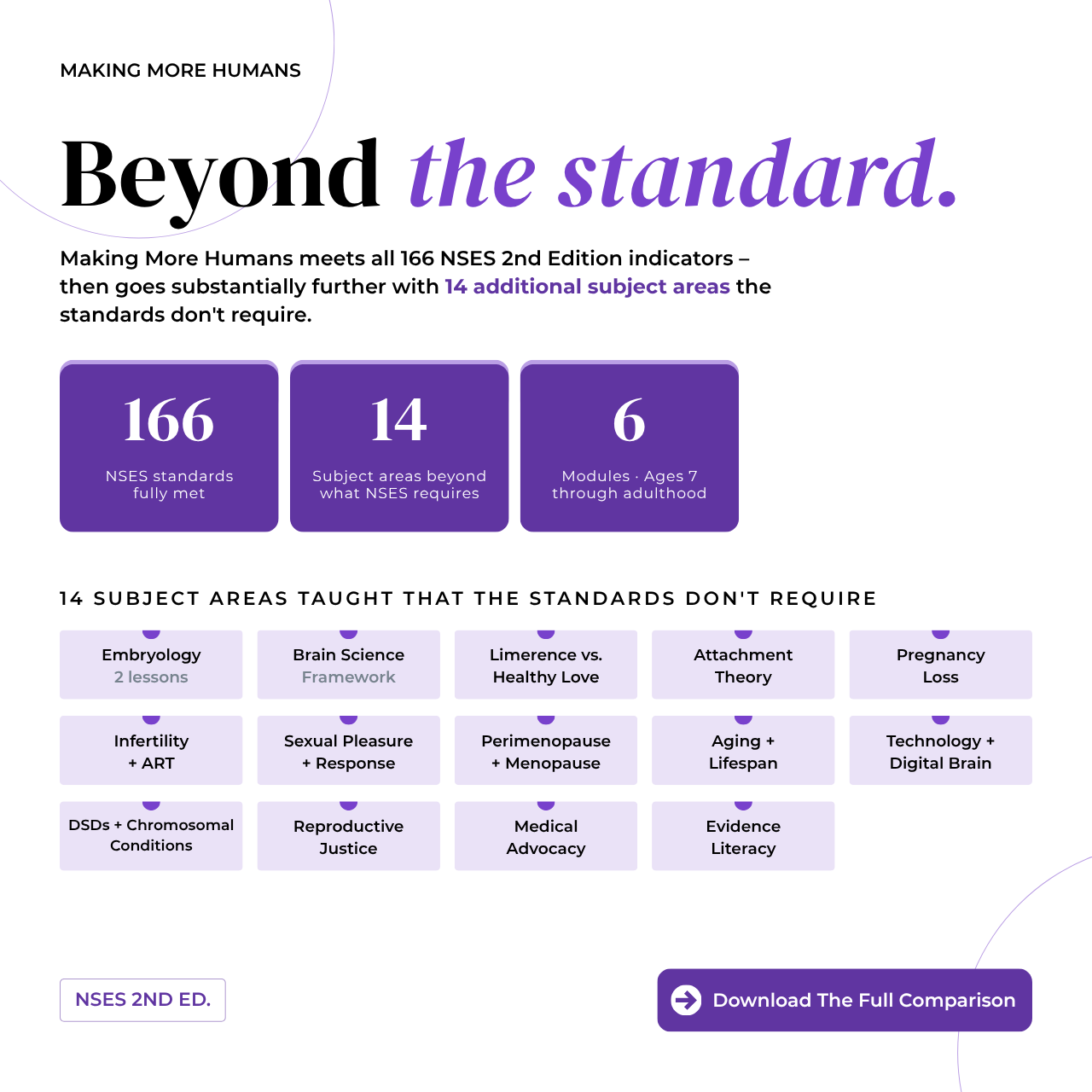
A: Usually not. Typical school programs cover reproduction mechanics and pregnancy or STD prevention, then stop. Consent, healthy relationships, full anatomy, and body literacy are mostly left to home. Even a program that meets all the the National Sex Education Standards (which Making More Humans does!) usually leaves out everything from pregnancy to infertility to menopause, all important parts of learning about human reproduction. Making More Humans covers fourteen subject areas beyond the NSES.
A: The ability to name, understand, and reason about your own body accurately. It lets a person describe symptoms, advocate for themselves, and recognize when something is wrong. It is the foundation everything else builds on.
A: Notice your own discomfort first, then treat the body as biology rather than a secret. Practice saying a “normal” body part name before one that you struggle with to get the tone right. You can also start over with your own sex education. Many parents get Making More Humans for themselves before using it with their kids. There’s even an audio podcast version so you can listen privately.
Reproductive health, abuse, and body-safety topics can be sensitive. If a conversation with your child surfaces a concern about their health or safety, your pediatrician or family physician is a good next step.
About Dr. Robin
Dr. Robin Dickinson is a family physician with a decade in private practice who has taught human biology to thousands of kids. She built Making More Humans to give families a clinically accurate, shame-free way to teach reproductive health at home. She teaches it in her own house, to her own kids, with her own family helping build the lessons. You can also watch her Making More Humans videos on YouTube.