Click on “CC” to get the subtitles!
There’s a part of medicine no textbook can teach your kid — and MedPath has a piece that exists entirely to teach it anyway. Because a student can learn every body system cold, ace every lab, reason through every case, and still be missing the single most important thing a healthcare provider needs.
They can still not understand what it actually feels like to live in a body with a medical condition or disability.
That understanding has a name. It’s called clinical empathy — knowing the science and knowing the person are two completely different things, and most people don’t learn the second one until they’re already standing in front of a patient. I don’t want your kid to wait that long. So we start early, and the way we start is Book Club.
Here’s how it works. Each month, MedPath and LifePath students have the option to read a book about a child or a teen living with a real medical condition — a kid their own age with type 1 diabetes, or who had a heart transplant, or who is learning to move through the world after losing their sight. Not just because they’re good stories, though they are, but because you cannot care for someone whose experience you’ve never once imagined. The book lets a student imagine what it’s like from the inside. Identify with the protagonist and root for them. I only choose books that are well written and interesting in which the main character has a medical condition or disability, and that portray the main character as a full person. Not an inspiration or someone who passively experiences their life and definitely not a book in which a miracle cure is the happy ending. These are characters who do interesting things and develop as people.
And it’s not just the book. Every month includes materials to help students get the most out of it. They start with a curriculum lesson that connects directly to that book’s medical condition — so the science and the human story lock together. There are three or four curated videos. And there’s a downloadable discussion guide to help you talk about it together. And also an optional project to do. It runs year-round, and it’s included in both MedPath and LifePath at no extra charge. There’s nothing else to buy.
So go look at what’s in there. See which book is up right now, read the discussion guide, watch one of the videos. The link is here and in your email.
But I want to leave you with the bigger thought, because you’ve now had a tour of MedPath — the lessons, the careers, the labs and cases, the video library, and this. And here’s what I hope you’re seeing. The science matters enormously — it’s real, it’s rigorous, and it’s the foundation of everything. But the science is just the beginning. What we build on top of it is a kid who can reason and care. A kid who’s sharp enough to read a chest X-ray and human enough to understand the person attached to it. That combination is rare, and it’s exactly what MedPath is built to grow.
Tomorrow, I’m going to show you exactly how to get your own student started — where they fit, which level is right, and how simple it is to begin. Go explore Book Club today, and I’ll be back in your inbox tomorrow.
p.s. Book Club is renamed BookPath: Stories for Life beginning fall 2026. Same great content, much more accurate name.
Middle grade novels are my favorite genre to read so it wasn’t a hard decision to share them with my students. But they are more than a fun time.
MedPath helps develop the whole clinician. Clinical thinking from day one, career exploration, and empathy for the person who actually has the condition.
p.s. Book Club is renamed BookPath: Stories for Life beginning fall 2026. Same great content, much more accurate name.
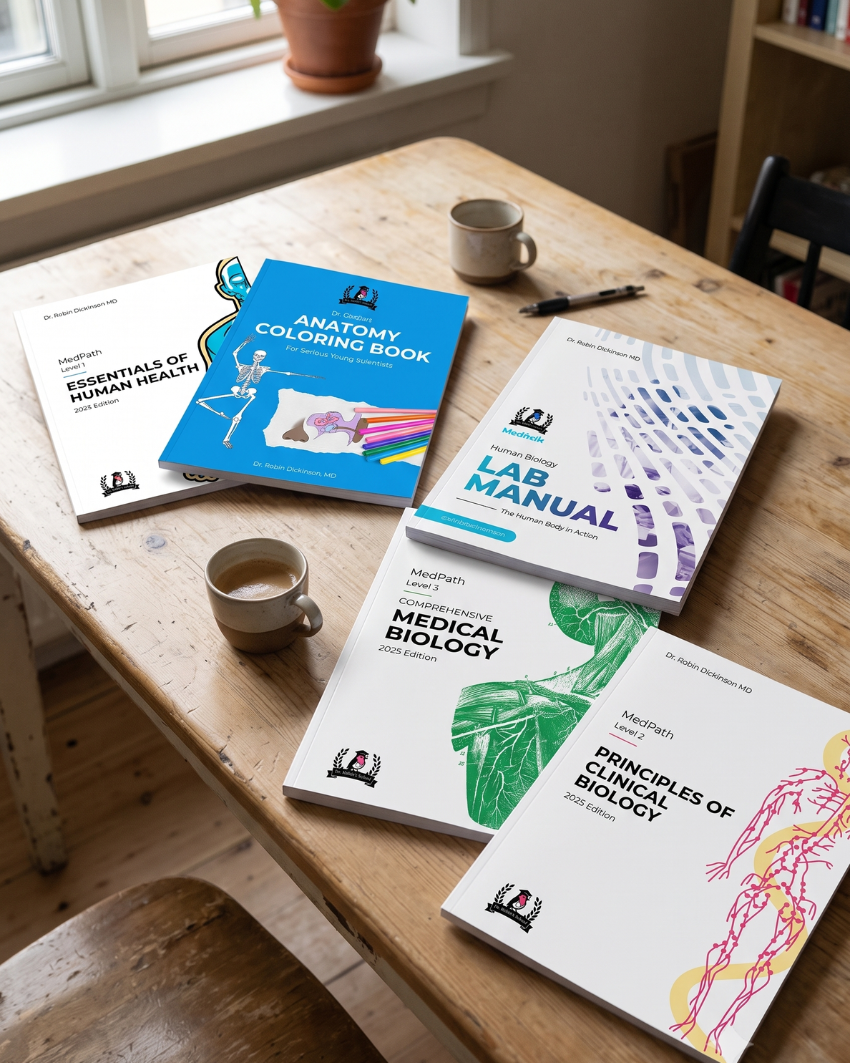
MedPath: Future Healthcare Professional is a physician-led curriculum in real medical science, built for kids and teens from kindergarten through high school. Four progressive levels covering anatomy, physiology, pathophysiology, and the full landscape of healthcare careers. I do the teaching, so you don’t have to.
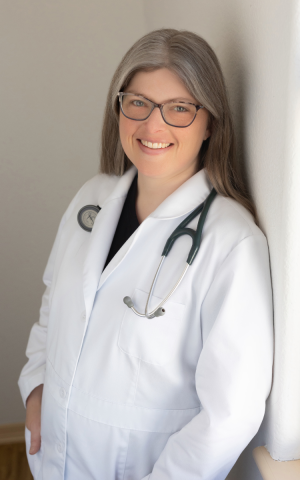
I’m Dr. Robin. I practiced as a family physician and set up my practice so I could spend a full hour with each patient, because teaching was always my favorite part of the visit.
When the pandemic started and I needed to be home for my two autistic kids, I sold my practice and started teaching online, and I discovered I loved it even more than medicine.
Since 2020 I’ve taught over 3,500 kids and teens worldwide. I built MedPath because there are coding classes for third graders and robotics teams for middle schoolers, and for a kid who wants to work in medicine, there was nothing.
I believed in how I was teaching but didn’t have any proof, until I did. Now every lesson is built around what that week showed me: kids can reason like clinicians long before anyone expects them to.
Part of it is preparing them for the path. The other is making sure they’re on the right one. Most kids are choosing from three careers because that’s all anyone around them can name.
People assume kids just follow along with dissection videos. What they actually do is work through the reasoning themselves, which is harder and matters more. Fun facts evaporate. Thinking doesn’t.
Every video in the library was tested with real kids before it earned a spot. Your student sees medicine as it actually exists, chosen by someone who knows what a clinician would want them to see.
Get personalized guidance from a real medical professional who understands, not a random support rep.